
California’s current energy-policy debates reflect decisions made over more than five decades. Disputes involving electricity rates, grid reliability, offshore oil, data-center demand, and wildfire liability operate within institutions and regulatory frameworks established during earlier periods of energy crisis, market restructuring, and climate-policy expansion.
How California’s Energy Policy Developed
Building the regulatory framework: 1973–1995
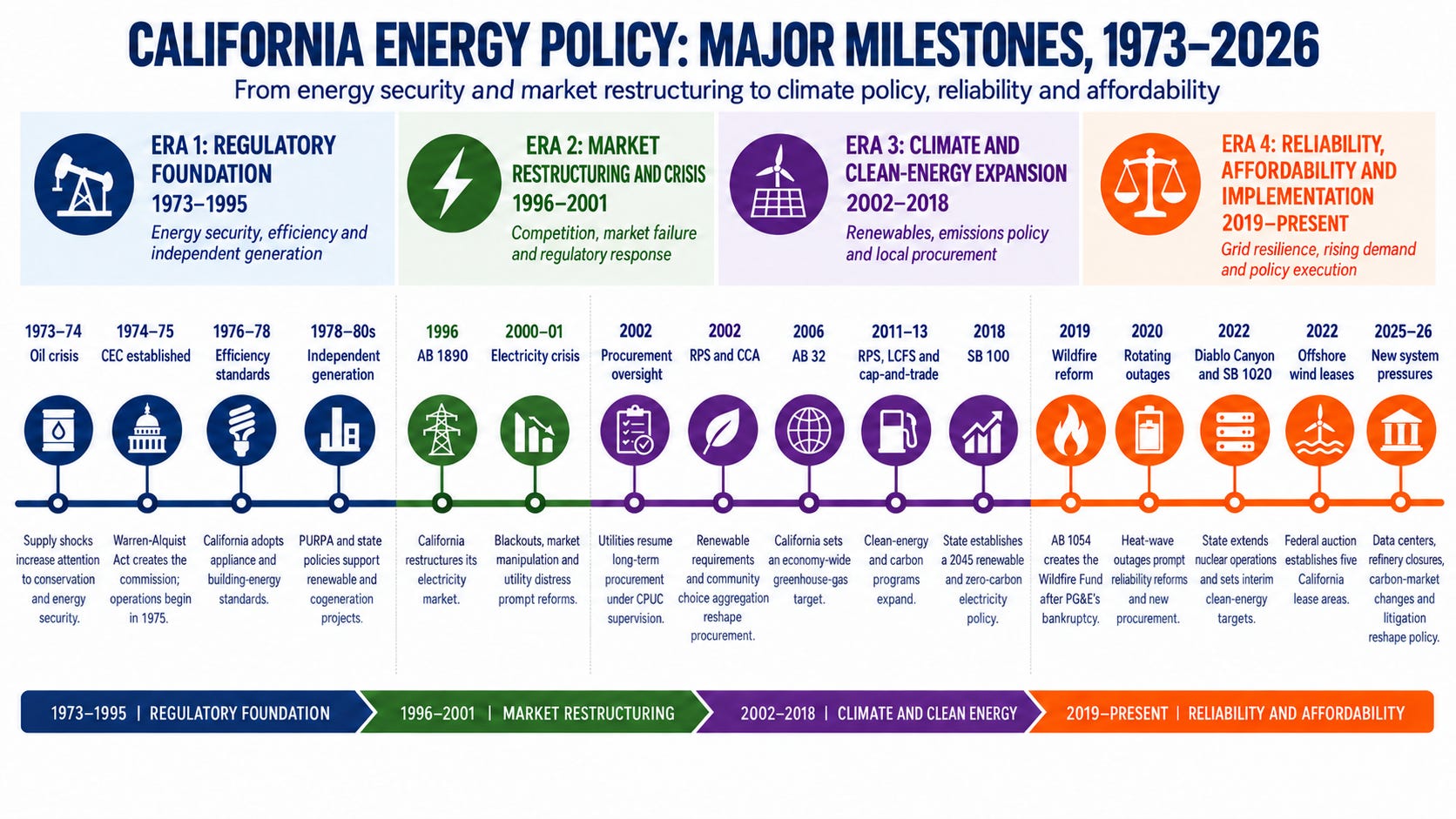
The oil shocks of 1973 and 1974 prompted California to strengthen state energy planning and conservation policy. The Warren-Alquist Act, enacted in 1974, created the California Energy Commission, which began operating in 1975 with responsibility for energy planning, power-plant siting, and efficiency programs.
California subsequently adopted building-energy standards under Title 24 and expanded appliance-efficiency requirements. These policies established energy conservation as a central part of the state’s response to supply constraints and rising demand.
The federal Public Utility Regulatory Policies Act of 1978, together with California procurement policies, also encouraged independent renewable and cogeneration projects during the 1980s. This created an early market for nonutility generation and helped establish the state’s wind, geothermal, and cogeneration industries.
Restructuring the electricity market: 1996–2001
California restructured its electricity industry through AB 1890 in 1996, introducing wholesale competition and changing how investor-owned utilities obtained electricity.
The restructuring contributed to the 2000–2001 electricity crisis, which included wholesale price increases, rolling outages, market manipulation, and financial distress for the state’s investor-owned utilities. California subsequently restored greater regulatory oversight and authorized utilities to resume long-term electricity procurement under California Public Utilities Commission supervision.
Expanding climate and clean-energy policy: 2002–2018
California adopted its first Renewable Portfolio Standard in 2002, establishing procurement requirements for renewable electricity. That year, AB 117 authorized community choice aggregation, allowing local governments to procure electricity for participating customers while investor-owned utilities continued providing transmission, distribution, and billing services.
The subsequent growth of community choice aggregators shifted a substantial share of electricity procurement from investor-owned utilities to local public entities.
AB 32, enacted in 2006, required the state to reduce greenhouse-gas emissions to 1990 levels by 2020 and gave the California Air Resources Board (CARB) responsibility for developing the principal implementation programs.
The state later implemented the Low Carbon Fuel Standard and a cap-and-trade program covering major sources of greenhouse-gas emissions. In 2018, SB 100 established a state policy of supplying all retail electricity sales with renewable and zero-carbon resources by 2045.
During this period, climate and emissions objectives became increasingly integrated into electricity, transportation, building and industrial policy.
Balancing reliability, affordability, and decarbonization: 2019–present
Wildfires, utility liability, and Public Safety Power Shutoffs returned reliability and infrastructure resilience to the center of state energy policy beginning in 2019. Following PG&E’s bankruptcy, AB 1054 established a state wildfire fund and a new framework for allocating the costs of catastrophic utility-caused fires.
Rotating outages during the August 2020 heat wave exposed weaknesses in resource planning and prompted accelerated procurement of battery storage and other reliability resources.
The Legislature’s 2022 decision to support the continued operation of Diablo Canyon beyond its previously planned closure illustrated the state’s renewed focus on resource adequacy. That year, SB 1020 established interim targets of 90% renewable and zero-carbon electricity by 2035 and 95% by 2040.
The federal government also held California’s first offshore-wind lease auction in December 2022, establishing five lease areas off the northern and central coasts.
More recently, expected electricity demand from artificial intelligence, data centers, and the electrification of transportation and buildings has increased attention to generation, transmission, and interconnection needs.
At the same time, refinery closures, changes to the state’s carbon-market program and litigation involving Sable Offshore Corp. have intensified questions about fuel supply, energy costs, and the pace of decarbonization.
Together, these developments have placed reliability, affordability and emissions reduction at the center of California’s current energy-policy decisions.
Related: Who Regulates Energy in California?