
A guide to the agencies, institutions, and overlapping jurisdictions that shape California energy policy.
California energy policy is administered through a divided system of state agencies, an independent grid operator, local governments, and federal regulators. No single institution controls electricity rates, resource procurement, grid operations, emissions, infrastructure permitting, and energy development.
This division of authority determines how quickly policies can be implemented and where disputes are resolved. A data center may require local land-use approval, a utility interconnection, CPUC rate treatment, CAISO transmission planning, and consideration in CEC demand forecasts. An offshore-energy project can involve federal leasing, state-land interests, coastal permitting, pipeline regulation, and judicial review.
Understanding developments in California energy policy therefore requires identifying both the policy decision and the institution with authority to implement it.
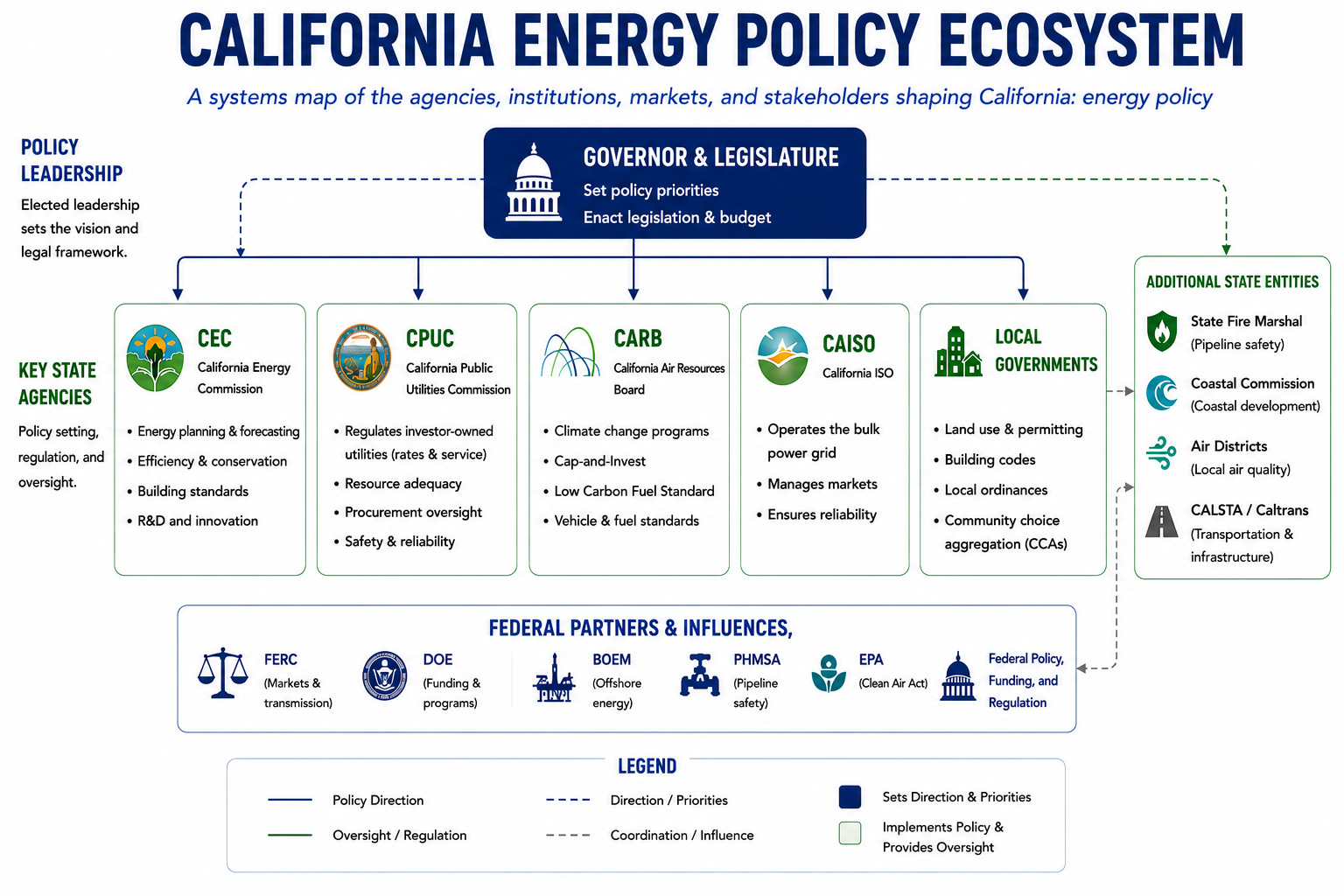
Governor and Legislature Set the Framework
The governor and Legislature establish California’s principal energy and climate objectives through legislation, the state budget, appointments, and executive action. They can assign responsibilities to state agencies, authorize programs, establish statutory targets, and determine how public funding is used.
They generally do not decide individual utility rates, approve specific procurement contracts, or operate the electricity grid. Those responsibilities are assigned to regulatory agencies and other institutions. The Legislature can change the authority of agencies, however, and frequently directs them to open proceedings, prepare reports, or adopt regulations.
The governor also appoints the five members of the California Public Utilities Commission (CPUC) and the five members of the California Energy Commission (CEC, subject to Senate confirmation. Members of the California Air Resources Board (CARB) are appointed through a combination of gubernatorial and legislative authority.
The Main Regulatory Authorities
California Energy Commission
The California Energy Commission is the state’s principal energy-policy and planning agency. Its responsibilities include forecasting energy demand, preparing the Integrated Energy Policy Report, administering building and appliance efficiency standards, supporting energy research, and overseeing state energy-emergency planning.
The CEC also licenses certain thermal power plants and administers an opt-in certification process for eligible clean-energy and manufacturing projects. Its demand forecasts inform electricity procurement and transmission planning, making the commission an important starting point for questions involving data-center growth, electrification, and future resource needs.
California Public Utilities Commission
The California Public Utilities Commission regulates privately owned electric and natural-gas utilities. It approves utility rates, reviews infrastructure spending, oversees electricity procurement, and administers programs involving resource adequacy, integrated resource planning, renewable energy, distributed resources, interconnection, and customer service.
For electricity customers served by investor-owned utilities, the CPUC is usually the principal forum for disputes involving rates and cost allocation. It also establishes resource-adequacy requirements for load-serving entities within its jurisdiction, including investor-owned utilities, energy service providers, and community choice aggregators.
The CPUC does not operate the bulk electricity grid or regulate publicly owned utilities in the same way it regulates investor-owned utilities.
California Air Resources Board
The California Air Resources Board is the state’s principal air-quality and climate regulator. CARB administers the state’s Cap-and-Invest carbon market program, the Low Carbon Fuel Standard, and major vehicle- and fuel-emissions programs. It also prepares the statewide Scoping Plan used to describe how California can meet its greenhouse-gas emissions targets.
CARB’s rules can affect electricity generation, transportation fuels, refineries, vehicles, and industrial facilities. Local air districts generally retain responsibility for permitting and regulating many stationary sources of local air pollution.
California Independent System Operator
The California Independent System Operator is a nonprofit public-benefit corporation rather than a state agency. It manages the flow of electricity across the high-voltage system serving most of California, operates day-ahead and real-time wholesale markets, dispatches participating resources, and conducts transmission planning.
CAISO manages real-time grid reliability, but it does not set retail electricity rates or determine California’s climate targets. Its market rules and tariff are subject to oversight by the Federal Energy Regulatory Commission.
Local governments and community choice aggregators
Cities and counties control many land-use, zoning, and local permitting decisions. Within the coastal zone, local authority may operate through a certified Local Coastal Program and remain subject to Coastal Act requirements and, in specified cases, Coastal Commission review.
Community choice aggregators procure electricity for participating customers within their jurisdictions. Investor-owned utilities continue to provide transmission, distribution, metering, and billing. CCAs must comply with applicable CPUC requirements, including resource adequacy, integrated resource planning, and renewable procurement obligations.
Publicly owned utilities, including the Los Angeles Department of Water and Power and the Sacramento Municipal Utility District, operate under separate governing structures and are not regulated by the CPUC in the same manner as investor-owned utilities.
Specialized state and regional authorities
Several entities control narrower but consequential parts of the energy system:
The California State Lands Commission manages state-owned tide and submerged lands, including state interests extending approximately three miles offshore. It issues leases, manages mineral resources, and regulates oil transfers at marine terminals.
The California Coastal Commission, together with coastal cities and counties, regulates development in the coastal zone. Its jurisdiction can affect offshore-energy infrastructure, pipelines, ports, transmission facilities, and other coastal projects.
The Office of Energy Infrastructure Safety reviews utility wildfire-mitigation plans, evaluates safety performance, and issues the safety certifications connected to California’s wildfire-liability framework.
The Office of the State Fire Marshal regulates the safety of intrastate hazardous-liquid pipelines under state law and federal certification. Federal authorities retain jurisdiction over interstate pipelines and pipelines beginning in federal waters.
Local and regional air districts issue permits and enforce air-quality rules for many stationary sources. Their decisions can affect refineries, power plants, backup generators, and industrial facilities in addition to CARB’s statewide requirements.
The California Department of Water Resources participates in electricity procurement and reliability programs when authorized by the Legislature. It also administers the state’s Wildfire Fund.
Federal authority establishes important limits
California’s energy system operates within federal statutes, regulations and approvals.
The Federal Energy Regulatory Commission regulates wholesale electricity sales and interstate transmission. It approves CAISO’s tariff and market rules and oversees interstate natural-gas transportation and oil-pipeline rates. FERC jurisdiction can determine whether a California policy affecting wholesale markets or transmission is permissible.
The Bureau of Ocean Energy Management manages energy leasing and development on the federal Outer Continental Shelf. California offshore oil and gas and offshore-wind projects require federal leasing and environmental review, as well as state and local approvals for associated onshore and coastal infrastructure.
The Pipeline and Hazardous Materials Safety Administration establishes and enforces federal pipeline-safety requirements. Its jurisdiction can depend on whether a pipeline is interstate, intrastate, or begins in federal waters. California’s Office of the State Fire Marshal enforces requirements for intrastate hazardous-liquid pipelines under authority certified by PHMSA.
The Environmental Protection Agency administers federal air and environmental statutes. EPA decisions are particularly important to California’s vehicle-emissions programs because the state generally requires federal authorization to enforce standards that differ from national requirements.
The Nuclear Regulatory Commission licenses the construction and operation of commercial nuclear facilities and regulates nuclear safety. State law and state regulatory decisions can separately affect whether a facility operates, how its electricity is procured, and which costs customers pay.
How authority overlaps
The same project or policy question can move through several institutions. The following examples illustrate the division of responsibility.
Electricity rates
The Legislature establishes statutory direction, but the CPUC decides the rates charged by investor-owned utilities through general rate cases and other proceedings. Utilities submit forecasts and proposed investments; consumer groups, businesses and other parties may participate in the proceeding. FERC separately regulates wholesale electricity and interstate transmission rates that can flow through to retail electricity bills.
Grid reliability and transmission
The CEC forecasts demand. The CPUC establishes procurement and resource-adequacy requirements for entities under its jurisdiction. Utilities and CCAs procure resources. CAISO operates the grid, administers wholesale markets, and identifies transmission needs. FERC oversees CAISO’s tariff and approves transmission-rate treatment.
Data centers and other large loads
Local governments determine land use and project permitting. Utilities study interconnection needs and may request new rate structures or infrastructure approval from the CPUC. The CEC incorporates expected load into demand forecasts, while CAISO evaluates regional transmission requirements. CARB and local air districts may regulate backup generation and associated emissions.
Offshore wind
BOEM controls federal leases and reviews construction and operations plans. The CEC coordinates state offshore wind planning. The State Lands Commission may control leases for cables or other infrastructure crossing state lands, while the Coastal Commission and local governments review coastal development. CAISO and the CPUC address transmission and procurement questions.
Offshore oil and pipelines
BOEM regulates energy development on federal offshore leases. The State Lands Commission manages state tidelands, submerged lands, and related leases. Coastal development may require approval from the Coastal Commission or a local government. Pipeline-safety jurisdiction may be divided between PHMSA and the State Fire Marshal, while other production activities can fall under the California Geologic Energy Management Division.
Utility wildfire safety and liability
The California Office of Energy Infrastructure Safety reviews wildfire-mitigation plans and safety certifications. The CPUC oversees utility rates, investments, and cost recovery. The Legislature establishes the statutory liability framework, while the Department of Water Resources administers the Wildfire Fund. Courts determine liability in individual cases.
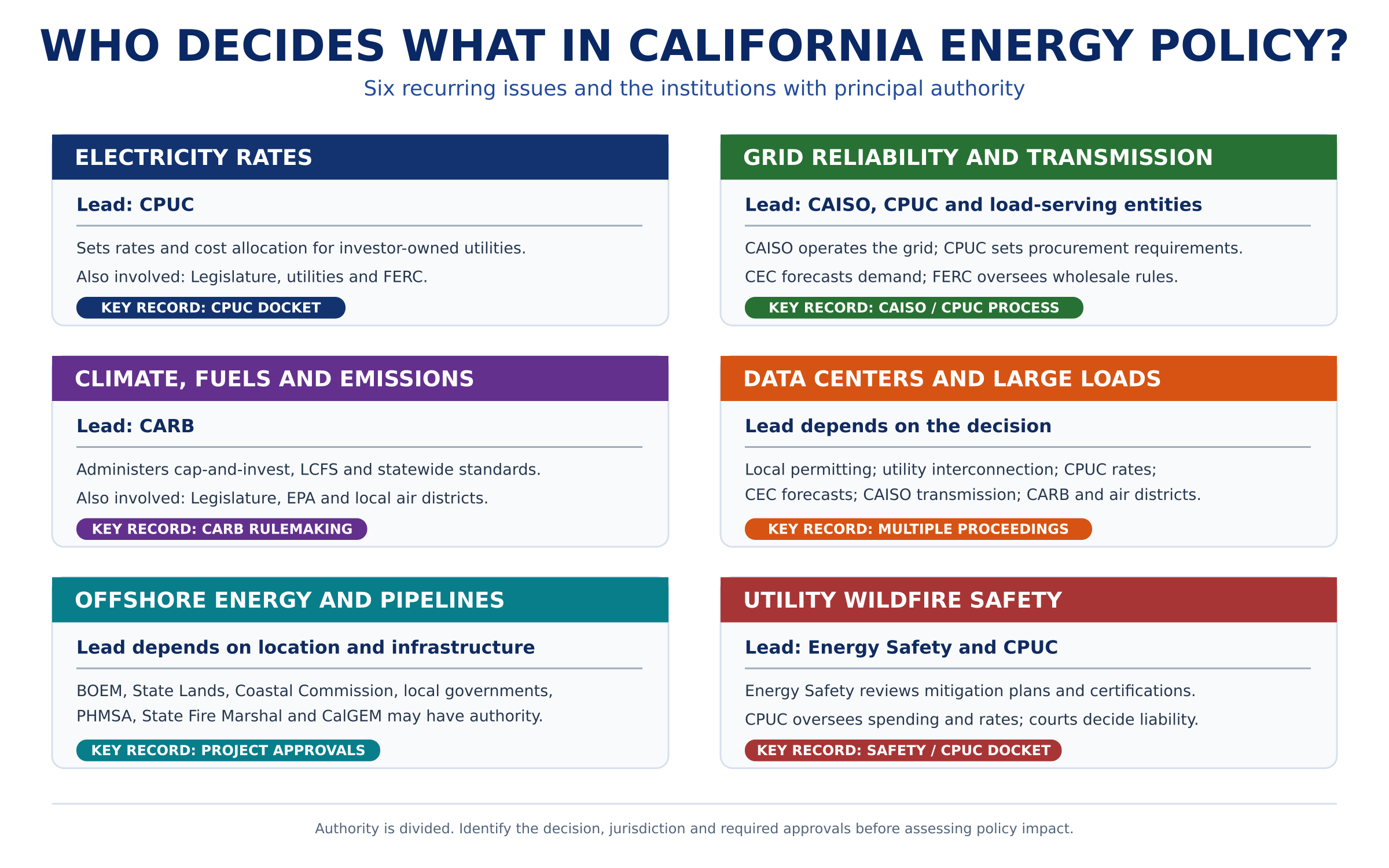
How to follow a California energy decision
The institution identifies the record that matters. Legislative proposals are tracked through bill text, committee analyses, and votes. CPUC decisions develop through formal proceedings that include applications, rulings, proposed decisions, and commission votes. CEC and CARB policies often proceed through workshops, staff reports, and rulemakings. CAISO uses stakeholder initiatives and transmission-planning processes, while FERC proceedings are organized by federal docket number.
For readers evaluating a new development, the starting questions are:
Which institution has legal authority over the decision?
Is the action legislative, regulatory, operational, contractual, or judicial?
Which other approvals must follow before the policy or project can take effect?
Who bears the resulting costs, obligations, or litigation risk?
Those questions distinguish an announced policy objective from an action capable of changing rates, infrastructure, market rules, or operating requirements.
Related: California Energy Policy Timeline